How to Read the AI Warning Bill Gates Delivers on The Ezra Klein Show
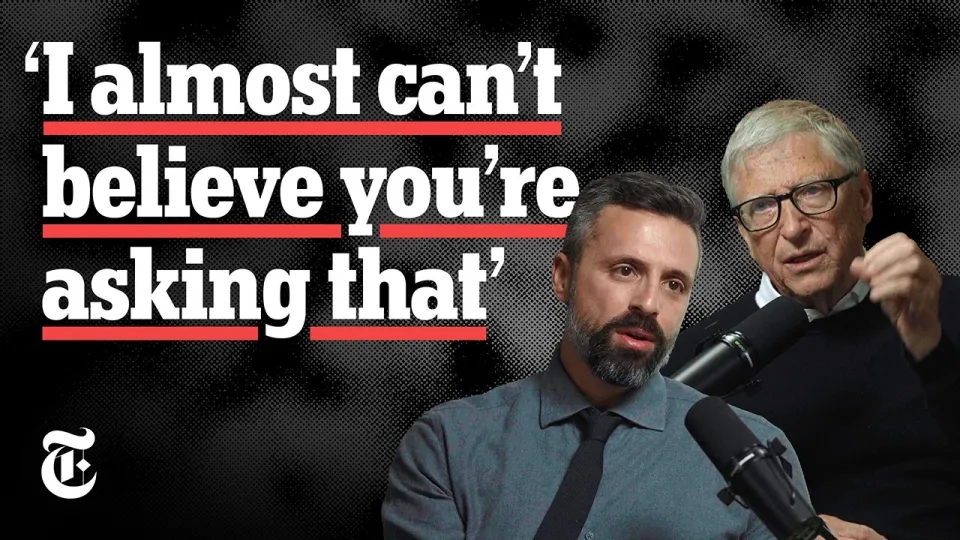
Video: Bill Gates: A.I. ‘Makes Nuclear Weapons Look Like Nothing’ | The Ezra Klein Show
Need articles like this for your video? They help promote it on YouTube and Google — order them in the Telegram bot @sat_sit_bot. The bot writes and publishes the articles itself (with your YouTube video embedded) on popular topical websites (no ads). Your first 50 articles are free.
· based on the channel The Ezra Klein Show
Key takeaways
- Gates says AI is the most dangerous technology humanity has approached, comparing its stakes to nuclear weapons.
- He calls industry self-regulation of AI "insane" and argues lawsuits cannot answer a catastrophe that kills millions.
- He names two thresholds: AI-enabled cyberattacks and bio-terrorism, plus mass job loss as the third shock.
- The Gates Foundation is set to spend down roughly $200 billion over two decades, with AI and inequality as a new priority.
- The interview aired on The Ezra Klein Show; the full transcript is published by The New York Times Opinion section.
Bill Gates argues that AI is the most dangerous technology humans have ever approached, that it makes nuclear weapons look almost trivial by comparison, and that the industry cannot be trusted to regulate itself. That is the core of his AI warning in a conversation with Ezra Klein, and the practical answer for readers is simple: treat AI risk as a policy problem with hard thresholds, not as a product-safety debate settled by lawsuits. The full transcript of the episode is available at the New York Times page for the Ezra Klein podcast episode.
Gates is not a newcomer to the subject. As Microsoft's co-founder and the chair of the Gates Foundation, he spent years as a technology optimist who treated artificial intelligence as a long-horizon curiosity. The shift in his position, described in the episode, is the interesting part: he now says the alarmism has not gone far enough, and that people in positions of authority are in denial about what is coming.
What Bill Gates actually claims about AI risk
Gates frames AI risk as a set of concrete thresholds rather than a vague existential mood. The first is cyber: AI that can find and exploit software vulnerabilities faster than defenders can patch them, enabling attacks on power grids, hospitals and financial systems. The second is bio: models that lower the barrier to designing and producing dangerous biological agents. The third is economic: a speed of job displacement that outruns the institutions meant to retrain and support workers.
The nuclear comparison is doing specific work here. Nuclear weapons are controlled by states, tracked by treaties and constrained by physical supply chains of fissile material. AI is controlled by private companies, distributed as software and improved on a quarterly cycle. Gates's point is not that AI is literally a bomb; it is that the safeguards around AI are far weaker than the safeguards around weapons, while the potential for harm is comparable or larger.
Why self-regulation fails in Gates's account
The sharpest moment of the interview is Gates dismissing the idea that AI labs can police themselves. His argument runs in three steps:
- Competitive pressure. Companies racing for market share cannot unilaterally slow down while rivals keep shipping.
- Liability is too slow. A lawsuit arrives years after harm, and no court settlement reverses a mass-casualty event.
- Voluntary commitments are unenforceable. Without a regulator with audit rights, safety pledges are marketing.
This is why Gates calls self-regulation "insane" and why he pushes back on the view, associated with Nvidia's Jensen Huang, that market incentives will naturally correct dangerous products. Gates's counter is historical: markets did not fix tobacco, leaded gasoline or ozone-depleting chemicals on their own. Regulation did.
The AI race with China and the safety trade-off
Gates treats the US-China AI competition as a real constraint on safety policy, not an excuse to abandon it. If one country pauses and the other does not, the pause buys little. The useful lever, in his framing, is coordination on the narrow set of things both sides fear: bioweapons, critical-infrastructure attacks and model weights that can be stolen or leaked.
That suggests a two-track approach. Compete openly on commercial AI, but build shared red lines and verification mechanisms for the highest-risk capabilities. Gates does not claim this is easy; he claims the alternative is worse.
Jobs, taxes and the "human reserved" category
On labor, Gates does not predict a sudden jobless world, but he does describe a no-scarcity job market in which human labor becomes a smaller share of economic output. Two ideas from the conversation are worth separating:
- Taxing AI labor. If machines produce value that used to come from payroll taxes, the funding base for social insurance erodes. Gates raises the idea of taxing automated labor as one way to refill it, while acknowledging the design problems.
- "Human reserved" jobs. Some roles — care, teaching, certain public services — may be deliberately reserved for people, both for quality and for social stability.
He also points to AI as a tool for global languages and education, especially where qualified teachers are scarce, and warns about learning loss in rich countries where devices arrived without pedagogy. On developing economies, his concern is that productivity gains concentrate in countries that already own the compute and the models, widening the inequality gap his foundation now treats as a priority.
The Gates Foundation is set to spend down roughly $200 billion over the next two decades, and Gates has said that steering AI toward equality rather than inequality is a new priority of that work.
Questions viewers keep raising about the AI debate
The reaction to the episode clusters around a few recurring doubts, and they are worth answering directly.
Is Gates exaggerating? He is making a comparative claim, not a prophecy. The nuclear analogy is about governance gaps, not blast radius. Readers can accept the comparison as a policy argument without accepting a timeline.
Does regulation mean slowing down? Not necessarily. Audit rights, incident reporting, compute thresholds and licensing for the most capable models are compatible with rapid deployment of narrow, low-risk tools.
Why trust a tech billionaire on this? Because the argument stands on its own: concentrated capability plus weak oversight plus competitive pressure is a known failure pattern. Gates's biography explains his access to the debate, not the validity of the claim.
What about children and education? Gates argues for age-appropriate rules and adult supervision rather than blanket bans, and warns that handing devices to students without teaching practice produces measurable learning loss.
Useful links
- Full transcript of the episode: https://www.nytimes.com/2026/09/29/opinion/ezra-klein-podcast-bill-gates.html
- Book recommendations from guests of the show: https://www.nytimes.com/article/ezra-klein-show-book-recs.html
The takeaway for anyone following AI policy
Gates's position is uncomfortable because it refuses both comforts: he will not say the danger is imaginary, and he will not say the market will handle it. The practical reading is that AI governance needs enforceable thresholds, fast incident reporting and international coordination on the highest-risk capabilities, while the economic transition needs a funding mechanism that survives the shift away from human labor. The Ezra Klein Show is the source of this exchange, and the episode is worth hearing in full precisely because Gates pushes back on the questions rather than smoothing them over. Start with the transcript linked above, then decide whether the risk framing changes how you use and regulate AI in your own work.
Source: Bill Gates: A.I. ‘Makes Nuclear Weapons Look Like Nothing’ | The Ezra Klein Show · Markdown version
Questions & answers
What exactly did Bill Gates say about AI and nuclear weapons?
He argued that AI is the most dangerous technology humanity has approached and that, in terms of stakes, it makes nuclear weapons look minor. The comparison is about weak oversight of a fast-moving software technology, not about AI being a literal weapon.
Why does Gates reject AI self-regulation?
He argues that competitive pressure makes voluntary slowdowns unrealistic, that lawsuits arrive years after harm, and that safety pledges without an auditor are marketing. In his view only enforceable rules with audit and reporting requirements change company behavior.
Does Gates think AI will destroy all jobs?
No. He describes a shift toward a no-scarcity job market where human labor is a smaller share of output, and he raises ideas such as taxing automated labor and reserving some roles for people, alongside AI use in education and language access.
Where can I read or listen to the full conversation?
The New York Times publishes the full transcript of the episode at https://www.nytimes.com/2026/09/29/opinion/ezra-klein-podcast-bill-gates.html, and the show's book recommendation list is at https://www.nytimes.com/article/ezra-klein-show-book-recs.html.